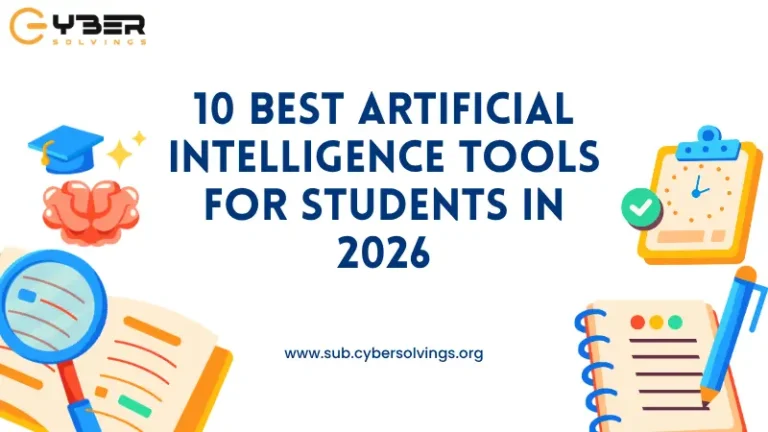
Education is going through one of the biggest shifts in its history, and artificial intelligence is at the center of it. From personalized tutoring to instant essay feedback, artificial intelligence tools for education are no longer a futuristic idea — they are part of everyday classrooms, study routines, and teaching workflows in 2026.
Whether you’re a student trying to study smarter, a teacher looking to save hours on grading, or a parent exploring options for your child, this guide walks you through everything you need to know. We’ll cover different artificial intelligence tools for education, the best free options available right now, and a curated list of the best artificial intelligence tools for education that are actually worth your time in 2026.
What Are Artificial Intelligence Tools for Education?
Artificial intelligence tools for education are software applications that use machine learning, natural language processing, and data analysis to support teaching and learning. Instead of a one-size-fits-all approach, these tools adapt to the individual — adjusting difficulty levels, offering instant feedback, summarizing content, generating practice questions, or even flagging where a student is struggling before a teacher notices.
Some artificial intelligence tools for education focus on students directly, helping with writing, research, or exam prep. Others are built for educators, automating grading, lesson planning, and administrative work. And a growing category serves entire institutions, using AI to track learning outcomes across thousands of students at once.
The common thread across all of them is simple: they use data and automation to make learning more personalized and teaching more efficient.
Why Schools and Students Are Adopting AI Tools in 2026
The adoption curve for AI in education has moved fast. A few years ago, AI in classrooms meant basic chatbots answering simple questions. Now, in 2026, we’re seeing far more sophisticated systems that can tutor a student one-on-one, adapt to different learning styles, and even predict which students are at risk of falling behind.
A few reasons are driving this shift:
1. Personalization at scale: A teacher with 35 students physically cannot give each one individual attention every day. AI tools can.
2. Instant feedback loops: Students no longer wait days for graded work — many AI tools give feedback in seconds, which speeds up learning.
3. Reduced administrative burden: Teachers spend less time on repetitive tasks like grading multiple-choice tests or drafting lesson plans from scratch.
4. Accessibility improvements: Text-to-speech, real-time translation, and reading-level adjustments have made classrooms more inclusive than ever.
5. Remote and hybrid learning support: AI tools help bridge the gap for students who aren’t always physically in a classroom.
Because of all this, the demand for the best artificial intelligence tools 2026 has to offer is higher than ever — and the market has responded with a wave of new, more capable platforms.
| Also Read: If you’re curious how AI is transforming other industries too, check out our guide on the role of artificial intelligence in marketing. |
Different Artificial Intelligence Tools for Education (By Category)
Not all AI tools serve the same purpose. To actually pick the right one, it helps to understand the different artificial intelligence tools for education available and what each category is built for.
1. AI Tutoring and Personalized Learning Tools
These tools act like a private tutor available 24/7. They assess a student’s current level, identify gaps, and generate a custom learning path. Instead of following a fixed curriculum, the tool adjusts in real time based on how the student performs.
Common features include:
- Adaptive quizzes that get harder or easier based on performance
- Step-by-step explanations for math, science, and language subjects
- Progress tracking dashboards for parents and teachers
2. AI Writing and Research Assistants
These are among the most widely used artificial intelligence tools for education, especially at the high school and college level. They help with brainstorming, structuring essays, checking grammar, and even citing sources correctly.
Good writing assistants don’t just fix mistakes — they explain why something is wrong, which reinforces learning instead of just correcting it.
3. AI Tools for Teachers
This category is built to save educators time. Instead of manually creating quizzes, rubrics, or lesson plans, teachers can generate a first draft in minutes and then refine it. Many tools also auto-grade assignments, including short written answers, using natural language understanding.
4. AI Tools for Students (Study Help, Flashcards, Summarization)
These tools focus on making studying faster and more effective. They can summarize long textbook chapters, turn notes into flashcards automatically, and generate practice questions based on uploaded material.
5. AI Tools for Accessibility and Special Education
This is one of the most impactful categories. AI-powered text-to-speech, speech-to-text, real-time captioning, and adaptive interfaces help students with learning differences or disabilities engage with material in a way that suits them.
Best Free Artificial Intelligence Tools for Education
Budget is a real concern for students, teachers, and schools alike, so it’s worth highlighting the best free artificial intelligence tools for education that don’t require a paid subscription to get real value.
1. Khanmigo (Khan Academy) – A free AI tutor built into Khan Academy’s platform, designed to guide students through problems without simply handing over answers.
2. Google’s AI Classroom Tools – Built into Google Workspace for Education, offering writing suggestions, auto-summarization, and accessibility features at no extra cost for eligible schools.
3. Quizlet’s Free AI Study Tools – Auto-generates flashcards and practice tests from uploaded notes, with a solid free tier.
4. Microsoft Copilot for Education (Free Tier) – Assists with research, writing, and study organization, integrated with Microsoft 365 tools many schools already use.
5. Grammarly Free – While not exclusively educational, its free plan is widely used by students for grammar, clarity, and tone feedback on essays and assignments.
6. Curipod – A free AI-assisted tool for teachers to build interactive lesson slides and polls in minutes.
These free artificial intelligence tools for education prove that you don’t need a big budget to bring meaningful AI support into learning. That said, free tiers often come with usage limits, which is where paid options come in for heavier or institutional use.
Best Artificial Intelligence Tools for Education (Overall Picks)
Now let’s look at the best artificial intelligence tools for education across both free and paid categories — the ones that consistently deliver real value to students, teachers, and institutions in 2026.
1. Khanmigo – Best overall AI tutor for K-12 students, guiding rather than giving direct answers, which encourages actual understanding.
2. ChatGPT for Education (Enterprise/Edu tier) – Widely used for research, writing support, and concept explanation across subjects and grade levels.
3. Microsoft Copilot for Education – Strong for institutions already using Microsoft 365, with deep integration into Word, Teams, and OneNote.
4. Google Gemini for Workspace Education – Excellent for collaborative assignments, summarization, and accessibility features within Google Classroom.
5. Century Tech – An adaptive learning platform used by schools to personalize lesson pacing based on real-time student data.
6. Socratic by Google – A free, student-friendly app that explains concepts step-by-step using photos of homework problems.
7. Grammarly for Education – The go-to writing assistant for improving clarity, grammar, and academic tone.
8. Nolej – Converts documents, videos, or PDFs into interactive learning modules automatically, useful for teachers building courses.
9. Gradescope – AI-assisted grading tool that speeds up evaluation of handwritten and typed assignments, popular at the university level.
10. Speak (AI Language Learning) – Uses conversational AI to help students practice speaking a new language with real-time feedback.
Each of these tools serves a slightly different purpose, so the “best” choice really depends on whether you’re optimizing for tutoring, writing support, grading efficiency, or language learning.
Best Artificial Intelligence Tools 2026 — What’s New
The best artificial intelligence tools 2026 has introduced go beyond simple chatbots. This year’s wave of tools focuses heavily on multimodal learning — meaning they can process text, images, audio, and video together to create a richer learning experience.
Some notable trends shaping the best artificial intelligence tools 2026 has to offer:
Voice-based AI tutors that let students ask questions out loud and get spoken explanations, useful for younger learners or those with reading difficulties.
AI-generated interactive simulations for science and engineering subjects, replacing static diagrams with tools students can manipulate.
Predictive analytics for teachers, flagging which students are likely to struggle with upcoming topics before test scores confirm it.
Stronger data privacy controls, as schools and parents push for tighter regulation around how student data is used and stored.
AI plagiarism and authenticity detectors that are more accurate at distinguishing AI-assisted work from fully AI-generated submissions.
If you’re evaluating tools this year, prioritize platforms that are transparent about data usage and have been updated recently — the pace of change means a tool from two years ago may already feel outdated.
How to Choose the Right AI Tool for Your Educational Needs
With so many artificial intelligence tools for education on the market, picking the right one can feel overwhelming. Here’s a simple framework to narrow things down:
1. Define the specific problem you’re solving: Are you trying to save grading time, help a struggling student, or make studying faster? Different tools solve different problems — don’t pick one just because it’s popular.
2. Check the budget: Start with free artificial intelligence tools for education if you’re testing the waters. Many free tiers are genuinely useful and only become limiting at scale.
3. Consider the age group and subject: A tool built for university-level research assistance won’t work well for a 7-year-old learning to read. Match the tool to the actual learner.
4. Review data privacy policies: Especially for younger students, check how the tool handles personal data, and whether it complies with relevant education privacy laws in your region.
5. Test before committing school-wide: If you’re an administrator, run a small pilot with a few classrooms before rolling a tool out across an entire school or district.
6. Look for tools that explain, not just answer: The best artificial intelligence tools for education guide students toward understanding rather than simply giving them the final answer. This distinction matters a lot for actual learning outcomes.
Benefits and Limitations of Using AI Tools in Education
Like any technology, artificial intelligence tools for education come with real benefits — and real trade-offs worth understanding before you rely on them heavily.
Benefits
- Personalized pacing for every student, regardless of class size
- Faster feedback, which helps students correct mistakes while the material is still fresh
- Reduced teacher workload, freeing up time for actual instruction and mentorship
- Better accessibility for students with disabilities or learning differences
- 24/7 availability, useful for students studying outside school hours
Limitations
- Risk of over-reliance, where students lean on AI instead of developing independent problem-solving skills
- Accuracy isn’t perfect — AI tools can still generate incorrect or oversimplified explanations
- Data privacy concerns, particularly for tools handling data from minors
- Unequal access, since not every student has reliable internet or a personal device
- Reduced human interaction if AI tools replace, rather than support, teacher involvement
The takeaway here is that AI tools work best as a supplement to good teaching, not a replacement for it. Used thoughtfully, they free up time and attention for the parts of education that genuinely need a human touch.
Conclusion
Artificial intelligence tools for education have moved from a novelty to a genuine necessity in modern learning environments. Whether you’re looking for free artificial intelligence tools for education to get started, or want to explore the best artificial intelligence tools for education available for serious, long-term use, there’s an option suited to nearly every need and budget in 2026.
The key is to start small, match the tool to your actual goal, and remember that AI works best when it supports human teaching rather than replacing it. As the best artificial intelligence tools 2026 continues to evolve, staying informed — like you’re doing right now — puts you ahead of the curve.
Have a favorite AI tool for learning or teaching that wasn’t mentioned here? Share it in the comments and help other readers on Cybersolvings discover what’s working for you.
Frequently Asked Questions
1. What are the best free AI tools for education?
Khanmigo, Google’s AI Classroom Tools, Quizlet’s AI study features, and Grammarly Free are among the most reliable free artificial intelligence tools for education currently available.
2. Which AI tool is best for students in 2026?
It depends on the need. For tutoring, Khanmigo is a strong pick. For writing support, Grammarly and ChatGPT for Education are widely used. For language learning, Speak stands out among the best artificial intelligence tools 2026 has introduced.
3. Are AI tools safe for classroom use?
Most reputable tools comply with education data privacy standards, but it’s important to review each platform’s specific policy, especially for tools used by younger students.
4. How do different AI tools for education compare?
They vary mainly by purpose — tutoring tools focus on personalized instruction, writing tools focus on grammar and structure, and teacher-facing tools focus on grading and lesson planning. Choosing the right one depends on whether you’re a student, teacher, or administrator.